LCP-Trigger

CASE STUDIES

Architecture Under Pressure. Engineering the Failure Boundary.
CASE STUDY #1

Deterministic Transaction Routing

Replacing Distributed Lock Contention with Partitioned Event Processing

A high-throughput FinTech payment platform suffered thread starvation, database connection pool exhaustion, and cascading transaction timeouts under heavy concurrency. SWARCS replaced Redisson-based distributed lock coordination with deterministic account_id partitioning, sequential state transitions, in-memory validation, and append-only persistence — reducing p99 latency from 4.5 seconds to 18 ms and increasing stable throughput from 3,200 to 18,500+ TPS.

[ High Concurrency ] [ Distributed Locks ] [ Deterministic Routing ] [ Kafka Partitioning ] [ Transaction Processing ] [ Event-Driven Architecture ] [ FinTech ]
CASE STUDY #2

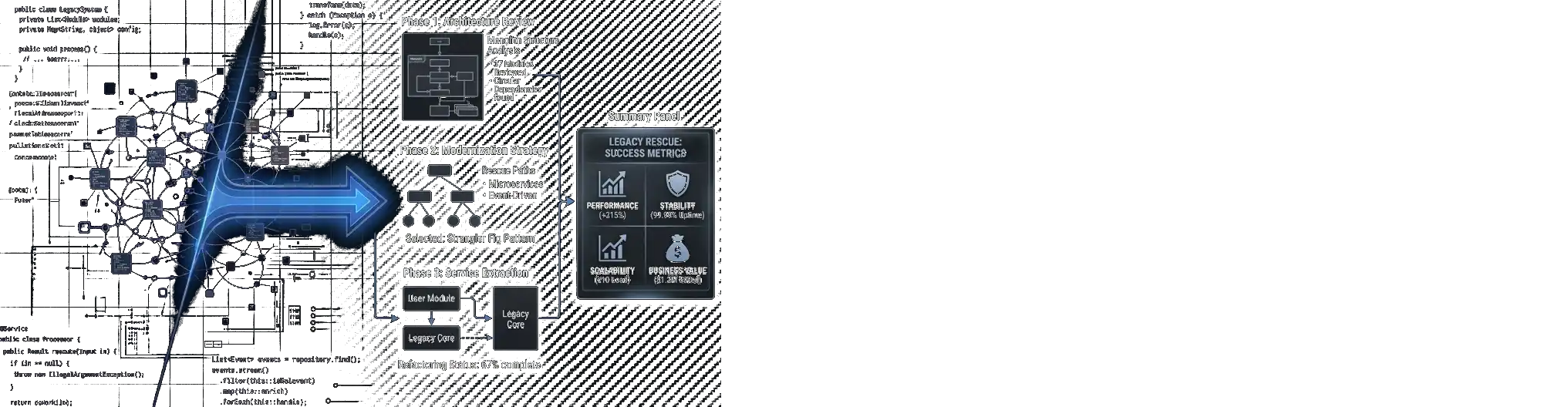
Zero-Downtime Legacy Modernization

Decoupling a Live Enterprise Monolith with CDC and Deterministic Data Ownership

A business-critical enterprise monolith could not tolerate planned downtime or a high-risk Big Bang migration. SWARCS introduced explicit domain write ownership, transaction-log CDC with Debezium, Kafka-based synchronization, idempotent consumers, and incremental Strangler Fig routing to extract business capabilities while production traffic remained live.

[ Legacy Modernization ] [ Zero Downtime ] [ Change Data Capture ] [ Deterministic Data Ownership ] [ Strangler Fig ] [ Event-Driven Architecture ]
CASE STUDY #3

Eliminating GC-Induced Reconnect Storms

Stabilizing a Real-Time System Through Allocation Profiling and G1GC Tuning

A real-time public safety system suffered severe memory allocation pressure, multi-second JVM GC pauses, and cascading WebSocket reconnect storms during peak message processing. SWARCS reduced allocation pressure through streaming payload processing, selective parsing, buffer pooling, and targeted G1GC tuning, reducing p99 GC pauses from 1,800+ ms to under 85 ms, with no observed connection drops or reconnect-storm events.

[ JVM Performance ] [ Garbage Collection ] [ Allocation Profiling ] [ Real-Time Systems ] [ WebSocket Stability ] [ Performance Engineering ]
CASE STUDY #4

Eliminating Cache-Miss Stalls

Stabilizing Real-Time Grid Traversal with Cache-Friendly CSR Layout

A real-time renewable energy grid platform suffered severe traversal latency caused by an object-heavy graph representation and memory-access stalls. SWARCS redesigned the graph around a cache-friendly CSR data layout, primitive arrays, a zero-allocation hot path and an explicit computational budget, reducing p99 latency from 620+ ms to 18 ms.

[ Performance Engineering ] [ Data-Oriented Design ] [ Cache Efficiency ] [ Real-Time Systems ] [ Graph Traversal ] [ Latency Engineering ]
CASE STUDY #5

Surgical Isolation of Poison-Pill Messages

Eliminating Rebalance Cascades with Edge Sanitization and Non-Blocking DLQ

Malformed partner records were triggering blocking fallback I/O inside Kafka consumers, exceeding max.poll.interval.ms and causing cyclic consumer-group rebalances. SWARCS moved validation to the ingestion edge and introduced surgical DLQ isolation with forensic metadata and controlled replay, preventing poison records from destabilizing the processing group.

[ Kafka ] [ Poison-Pill Isolation ] [ Dead-Letter Queues ] [ Event-Driven Architecture ] [ Failure Isolation ] [ Backpressure ]
CASE STUDY #6

Eliminating Consumer Lag and Resource Contention

Deterministic Partitioning and Backpressure-Aware Bulk Indexing

A real-time analytics pipeline developed 45–60 seconds of consumer lag during traffic spikes despite apparently healthy infrastructure metrics. SWARCS eliminated cross-consumer contention through deterministic zone_id partitioning and replaced one-document-at-a-time Elasticsearch writes with bounded bulk processing and backpressure control, reducing lag to under 50 ms without expanding the cluster.

[ Kafka ] [ Consumer Lag ] [ Elasticsearch ] [ Backpressure ] [ Bulk Indexing ] [ Data Ownership ] [ Performance Engineering ]